
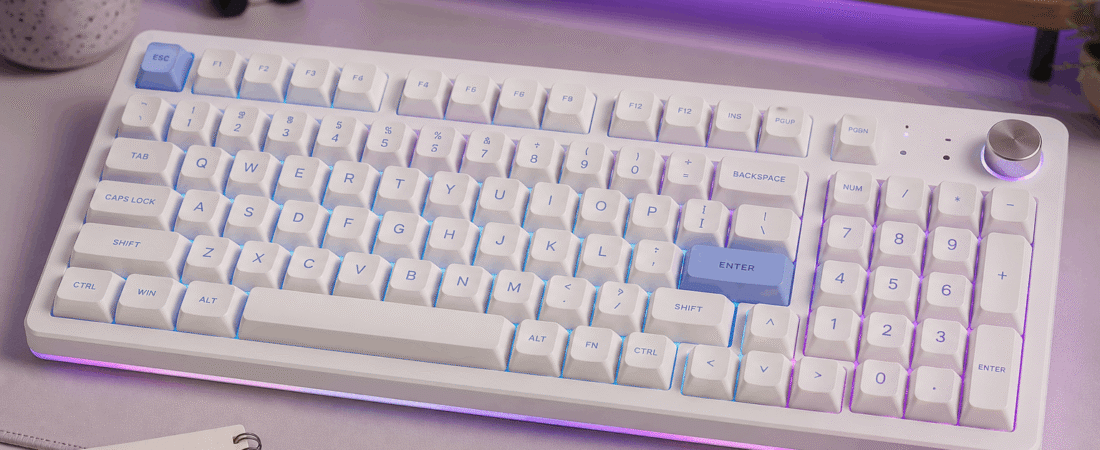
Full review: specs, switches, sound profile, build quality, software, who it’s for, and the bottom line.
Disclosure: This post contains affiliate links. If you buy through them, we may earn a small commission at no extra cost to you.
Image for illustrative purposes only. The keyboard pictured is not the HUO JI E-Yooso reviewed in this article.
The HUO JI E-Yooso (sold as the Z-99) is a wired 96% mechanical keyboard built almost entirely around one goal: sounding and feeling “creamy” for very little money. Instead of spending its budget on wireless radios or screens, it puts that money into the parts that shape typing feel, namely a gasket-style internal structure, several layers of sound-dampening foam, and factory-lubed linear switches on a hot-swap board. It keeps a full number pad and arrow keys in a body noticeably shorter than a full-size keyboard.
The trade-off is simple and worth knowing up front: there’s no Bluetooth or 2.4GHz option. If you’re happy staying plugged in, it’s one of the most sound-focused boards you can buy at this price.
Specs at a Glance
Pros and Cons
⌨ Pros
- Remarkably soft, muted sound for a budget mechanical board
- Hot-swap sockets accept both 3-pin and 5-pin switches, no soldering
- Factory-lubed linear switches feel smooth from day one
- Keeps a number pad and arrows in a shorter-than-full-size footprint
- Wired connection means zero input lag concerns and no battery to charge
- Detachable cable makes it easy to move or replace
⚠ Cons
- No wireless option at all
- Plastic case, not aluminum
- 96% layout pushes keys together, which takes some getting used to after a full-size board
- Weight and some detailed specs aren’t clearly published
- Software and deep customization are limited compared to enthusiast brands
Soft, muted and creamy, with very little hollow echo
Switches Used
The Z-99 ships with linear switches that are lubricated at the factory, so they glide straight down with no tactile bump and no click. That smoothness is a big part of the creamy feel, and it means you don’t need to lube anything yourself to get a good result out of the box. The board is also hot-swappable with sockets that take both 3-pin and 5-pin switches, and a puller is included. If you later want something with a tactile bump, a heavier spring, or a different sound, you can pull the stock switches and press in new ones in minutes.
Sound Profile
This is the keyboard’s whole reason for being. Cheap mechanical boards usually sound hollow because there’s empty space inside the case that echoes every keystroke. HUO JI fills that space with layers of sound-absorbing foam and a silicone dampener, and the manufacturer claims this cuts overall noise by about 40% and hollow sound by about 80%. Those are the company’s own figures, not independent measurements, but buyer descriptions line up with the general idea: a soft, rounded, muted sound rather than a sharp clack. It isn’t silent like a membrane board, but it’s far easier on the ears than most mechanical keyboards in its price range.
Build Quality and Daily Use
The case is plastic, which is expected at this price, but the internal foam and gasket-style mounting give it a more solid, less rattly feel than a bare plastic shell would. The 96% layout keeps every key you’d find on a full-size board, including the number pad, by tucking the arrow and navigation clusters closer together. That saves a few inches of desk space for your mouse, though people coming from a standard full-size keyboard often need a few days to stop reaching for keys in their old spots. Because it’s wired, there’s no charging routine and no wireless dropout to worry about during games.
Software and Compatibility
Lighting effects and colors can be changed directly from the keyboard with FN shortcuts, so most people never need to install anything. It works with both Windows and Mac computers over USB, and full N-key rollover means every key you press at the same time registers correctly, which helps in fast games. There’s no QMK or VIA support, so if you want deep firmware-level remapping or layers, an enthusiast board is a better fit.
Who It’s For
Who It’s For
Desk-bound typists, students, and gamers who care most about a pleasant, creamy typing sound, want a number pad, and are happy using a cable in exchange for a lower price and zero battery hassle.
Who Should Skip It
Anyone who needs Bluetooth or 2.4GHz wireless, wants to switch between multiple devices, or prefers a premium aluminum case and firmware-level customization.
What the Reviews Say
To evaluate the E-Yooso, we compared the manufacturer’s published specifications across retailer listings and looked at recurring themes in buyer feedback and independent roundups, rather than relying on any single opinion. A 4.6-star average from more than 700 ratings is a strong result for a budget mechanical keyboard and suggests most owners get what they expected.
The praise focuses on the sound above all else, with owners frequently describing it as soft, smooth, and far nicer than they expected for the money. The light, buttery keypress of the pre-lubed switches and the look of the RGB lighting come up often too, and some Mac users mention it connected without any setup. The criticism is just as consistent and fairly predictable: the most common wish is for a wireless version, and a few buyers moving over from a full-size layout said the tighter 96% spacing took a little time to adjust to.
Value for the Price
At its typical $40 to $50 street price, the E-Yooso is one of the strongest values on this list if sound and feel are your priorities. By skipping wireless and a battery, it can spend its budget on dampening and lubed hot-swap switches instead, which is where you actually notice the difference while typing. If you see it listed closer to $90 from a third-party seller, though, wait for the regular Amazon price, because at that level wireless gasket boards become direct competition.
If you want that soft, creamy mechanical sound with a number pad and don’t need wireless, the HUO JI E-Yooso puts its money exactly where it counts. It’s a no-fuss, plug-in board that types and sounds like it should cost more.
700+ reviews · 4.6 stars